
An itinerary tells you when the ship leaves and when it docks. It has nothing to say about the hours on either side of those two numbers — and those are the hours that decide which version of you boards, and how much of the trip survives the trip home.
I found that out by accident, in a hotel in Rotterdam that used to be an office building.
Schiphol is a lot. It’s enormous and busy and every sign is competing with four other signs for your attention, and I’ve never once walked through it feeling like a person in full possession of his faculties. But the part I was braced for turned out to be the easy part. Off the plane, follow the signs down to the trains — clear, and in English. I skipped the machines, went to the ticket counter, told the guy where I was headed. He built the whole thing in about ninety seconds: train to Rotterdam Centraal, then the metro south to Wilhelminaplein.
Which I cannot pronounce. And I did not spell it just now either. I copied and pasted it.
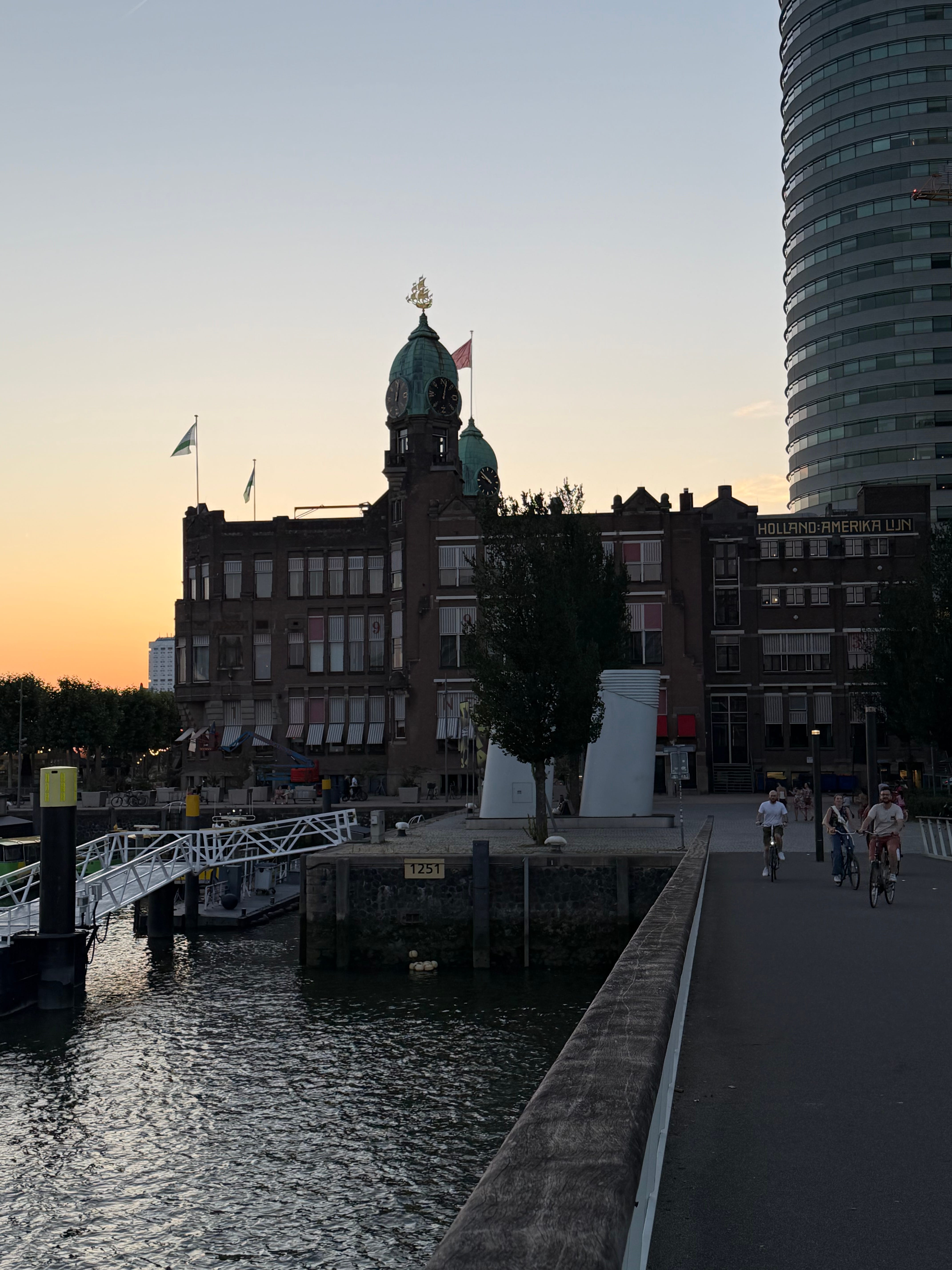
An hour after I picked up my bag, I was standing at the end of a pier in Rotterdam, looking up at the words Holland America Line. Not on a ship. On a building — red brick, two green copper towers, built in 1901, looking like it was dropped in from a different century than everything around it, which in Rotterdam it more or less was. This was the Line’s head office. Roughly a million people came through here on their way out of Europe, leaving from the same pier where I was about to board a ship and go look at Scotland for two weeks.
The Line moved to Seattle in 1977. The building sat empty, then squatters had it, then the city bought it. It reopened as a hotel — Hotel New York — in 1993, and it’s the least cookie-cutter place I’ve stayed in a long time. Old brick building turned into loft apartments: wood floors, high ceilings, modern finishes dropped into a hundred-year-old structure. Big bed, big bathroom, Nespresso on the counter. A bathtub sitting out in the room instead of the bathroom, because they upgraded me at check-in — the room on my second stay didn’t have it. The air conditioning cleared my bar, which is a higher bar than most people’s. Front desk excellent the whole time, no blink sliding into English.
Makes sense once you remember what these rooms used to be. They weren’t rooms. They were offices.
I’d booked it on purpose — saw it on a map a few hundred yards from the cruise terminal and thought, good, that solves a problem. What I hadn’t understood is that a map and a window are two different pieces of information. The ship isn’t a dot on a screen. It’s the view. I drank my morning Nespresso looking at the Nieuw Statendam, and that does something to your nervous system a hotel near an airport never does. Nothing left to arrange. Getting aboard asked nothing of me except that I keep putting one foot in front of the other.
There are rental bikes out front. There are also motorized scooters that come with helmets, which I chose to read as a warning label. I ran the numbers — not on cost, on the odds of spending my evening in a Rotterdam emergency room instead of my morning on that ship — and walked instead.
Across the Rijnhaven pedestrian bridge, ten or fifteen minutes on foot, is Katendrecht. For about a hundred years this was where the port came ashore — sailors’ quarter, Chinatown, red-light district. Now it’s a small pedestrian square called Deliplein, ringed with terraces. I had coffee at a place called Kopi Soesoe, Indonesian angle, the general atmosphere of somebody’s very good living room.
There was a market on the square that Saturday. Not a tourist market — artists, craftspeople, a table of old maps, a neighborhood buying its food outdoors on a weekend. A stroopwafel trailer pressing them fresh, which is not the thing in the plastic sleeve at the airport, same name, different food. A fry truck, because it’s the Netherlands. And then the strawberries — a carton from a woman at a produce stall, tap the phone, take the fruit, best strawberries I’d had in years. I wanted them aboard, but had no idea if fresh fruit was allowed on the ship and had to decide standing right there. I hedged: one more carton, that was it. Nobody on the ship cared even slightly. I should have bought the cherries too.
A few doors off the square is a tattoo shop — the last one left from when this neighborhood was the tattoo capital of the Netherlands, sailors getting marked before shipping out. Started in a cellar in 1968, his kids work the counter now. I wanted the t-shirt, not the tattoo, but he doesn’t open until midday and by midday I was on a ship.
Five minutes away is the Fenix, a migration museum in an old harbor warehouse — one subject, people leaving and arriving and what the crossing does to them. The centerpiece is a labyrinth built from more than two thousand real suitcases, donated from all over the world. I walked through it the day before boarding a ship, a few hundred yards from the pier where a million people left Europe for good.
I could have trained up to Amsterdam instead. Done the museums, the canals, come back sweaty and spent. I stayed around one square instead, and I’d make the same call again.
The next morning I walked to my ship — out the front door, flat the whole way. And I booked the same hotel for the night I got off, which was the deliberate part. Disembarkation morning, a couple thousand people move toward the same airport in the same hour, and I know what that does to me — something in my chest goes flat and tactical, fourteen days of attention gone in forty minutes of luggage math. So I slept in. No line, no crowd. Dropped my bags, walked back across the bridge, had breakfast outside while Rotterdam and I both woke up slowly.
That’s not a travel hack. It’s a buffer. A night on the front end to arrive before I arrive. A morning on the back end to come down on my own clock, in a city I’m in no hurry to leave.
Next time I’ll take two.
The practical bits
Getting there. Schiphol to Rotterdam Centraal by train, then metro line D or E south to Wilhelminaplein. Roughly eight minutes on foot from that station to the hotel. The ticket counter at the airport will build the whole route for you and it costs nothing extra to ask.
The hotel. Hotel New York, at the end of the Wilhelmina pier. Book a room facing the water if you can.
The neighborhood. Out the back, across the Rijnhaven pedestrian bridge, into Katendrecht. Deliplein for coffee and dinner. The Fenix for the museum. Check whether the market is running — it’s worth timing your stay around.
The terminal. Five to ten minutes on foot from the hotel door, flat the whole way. No cab required unless your luggage situation says otherwise.
The move. One night before, one night after.
Sean owns Slow Crossings, where he designs trips for travelers who want it done right and offers coaching for life’s bigger transitions — if either’s ever useful, reply or check the About page.