

There is a piece of advice that gets handed out often enough in coaching and in self-help that it might as well be written on a poster somewhere.
Trust yourself.
Trust your instincts. Trust your gut. Trust your inner voice. Listen to the part of you that knows.
I have probably said some version of that out loud to another human being. I have definitely thought it about myself. It is, most of the time, good advice.
It is also, some of the time, dangerously wrong.
I spent most of the last month in various states of poor judgment, and I did not know I was in them at the time. I made decisions that felt deliberate. I told myself stories about those decisions that sounded like intentionality. In several cases I could have cited the framework I teach to defend the decision I was making.
Only afterwards — days later, sometimes weeks — did I look back and realize I had not been making decisions at all. I had been reacting. Wearing the vocabulary of intentionality while doing something else entirely.
The worst part is I could not feel the difference from the inside.
And when I tried to go back and identify the moment things went sideways, I could not find one. There was no bell that rang. No internal alarm. The decisions felt clear. They felt like mine. They felt, in some cases, like breakthroughs.
They were, it turns out, the opposite.
What was actually happening is worth naming, because I don’t think it’s only my problem.
My nervous system was overloaded. By travel. By poor sleep. By physical pain. By an itinerary I should have simplified six months earlier. By all of them at once, compounding each other in ways I did not stop long enough to inventory.
And when your nervous system is overloaded, your perception changes. Not just your mood. Not just your energy. Your actual read on reality.
The world does not look overloaded. The world just looks worse. Harder. More hostile. More bleak. More clear, in a particular flattening way — as if the difficulty of everything has finally revealed itself. The fog lifts, you think. Now I see.
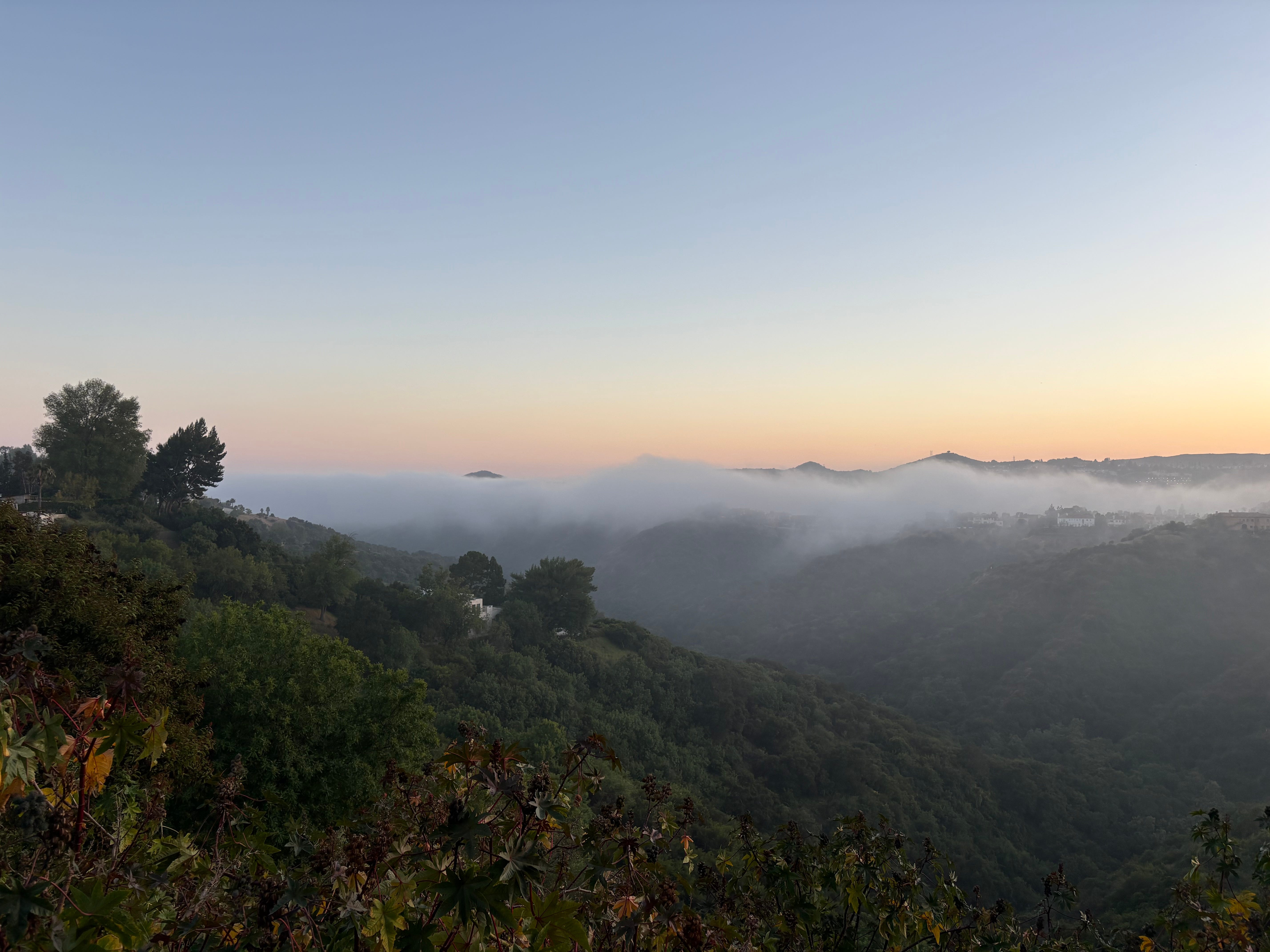
What has actually happened is the fog has thickened so completely that you cannot see it. You have started mistaking the weather inside your nervous system for the shape of the world outside it.
And the decisions you make from inside that state do not feel compromised. They feel urgent, decisive, accurate. They feel like finally waking up.
This is not a new idea. Polyvagal researchers have described it at length. There is a name for the territory I’m describing — the place where our usual ways of knowing fail us, where the reliable self we had been before no longer answers questions reliably. The neutral zone, some people call it. The between.
But I did not feel any of this as theory last month. I felt it as the plain experience of making a sequence of confident wrong decisions while trusting that I was making good ones.
I teach this.
I know about nervous system regulation. I know about depletion and its effects on cognition. I know that the space between what’s ending and what’s beginning is exactly when your system is most likely to be compromised — because change is stressful, and stressful is dysregulating, and dysregulated is when your perception stops being reliable.
I knew all of that. And I still could not see it happening to me.
Which means — and this is the hard part — that trust yourself is bad advice in exactly the territory where people most need good advice.
I am starting to think about this differently. Not as better decision-making. Not as sharper instincts. Not as a more finely tuned gut.
The skill might be knowing when you are not qualified to be making decisions at all.
That sounds like a loss of agency. It is not. It is the opposite. It is the agency of recognizing that the instrument you are about to use — your own perception — is compromised, and that the responsible thing is to delay, to consult, to sit with, to not decide yet.
I don’t trust my read on this right now, and I’m going to wait is a more sophisticated move than any decision you could make from a depleted state. It is also a move most of us are not trained to make. We are trained to be decisive. To trust our instincts. To know what we want. To be clear.
The between punishes that training.
In the between, your instincts are confused because the self that developed them is the self that is ending. Your wants are confused because the identity that wanted things is the one that no longer fits. Your clarity is confused because clarity, at a certain point, requires having something to be clear about — and the between is precisely the territory where that is not yet true.
In the between, trusting yourself can mean trusting the version of yourself that is exhausted, grieving, scared, and looking for a way out of the discomfort. That version will make decisions. Those decisions will feel real. They will not, most of the time, be the ones you actually need to make.
I am not suggesting paralysis. Nothing would be less useful to a person in transition than an instruction to stop deciding anything.
I am suggesting a narrower practice.
Before any decision in the between that cannot easily be undone, ask one question: am I in a state where my perception can be trusted?
Not do I feel clear. Clarity is not the test. Overloaded nervous systems produce a distinctive kind of false clarity. I would know.
The better tests are physical and practical. Have you slept? Are you in pain? Have you been still in the last forty-eight hours? Is there anyone whose read on this you respect who has not seen the decision you are about to make? Would you be embarrassed by this decision in front of a rested, regulated version of yourself?
If any of those answers are wrong, the decision probably needs to wait. Not forever. Long enough for your state to shift. Long enough to find out whether the certainty you are feeling is real clarity or the specific kind of fog that mimics it.
I am back from a long passage now, and I am a little embarrassed by some of the decisions I made while I was inside it. I am also grateful — in the way that only the post-embarrassed are — to have learned, in my own body, what it feels like to not know you cannot trust yourself.
I would not have learned it if someone had told me. I had to live it to believe it.
Which is, I suspect, one of the quieter truths about the between. Some of what it has to teach you can only be learned the hard way.
That does not mean you have to learn it the way I did.
You could, instead, start by taking seriously the possibility that trust yourself is not a universal instruction. That there are states, and windows, and conditions in which the most trustworthy thing you can do is notice that you are not qualified to see clearly right now.
And wait.