
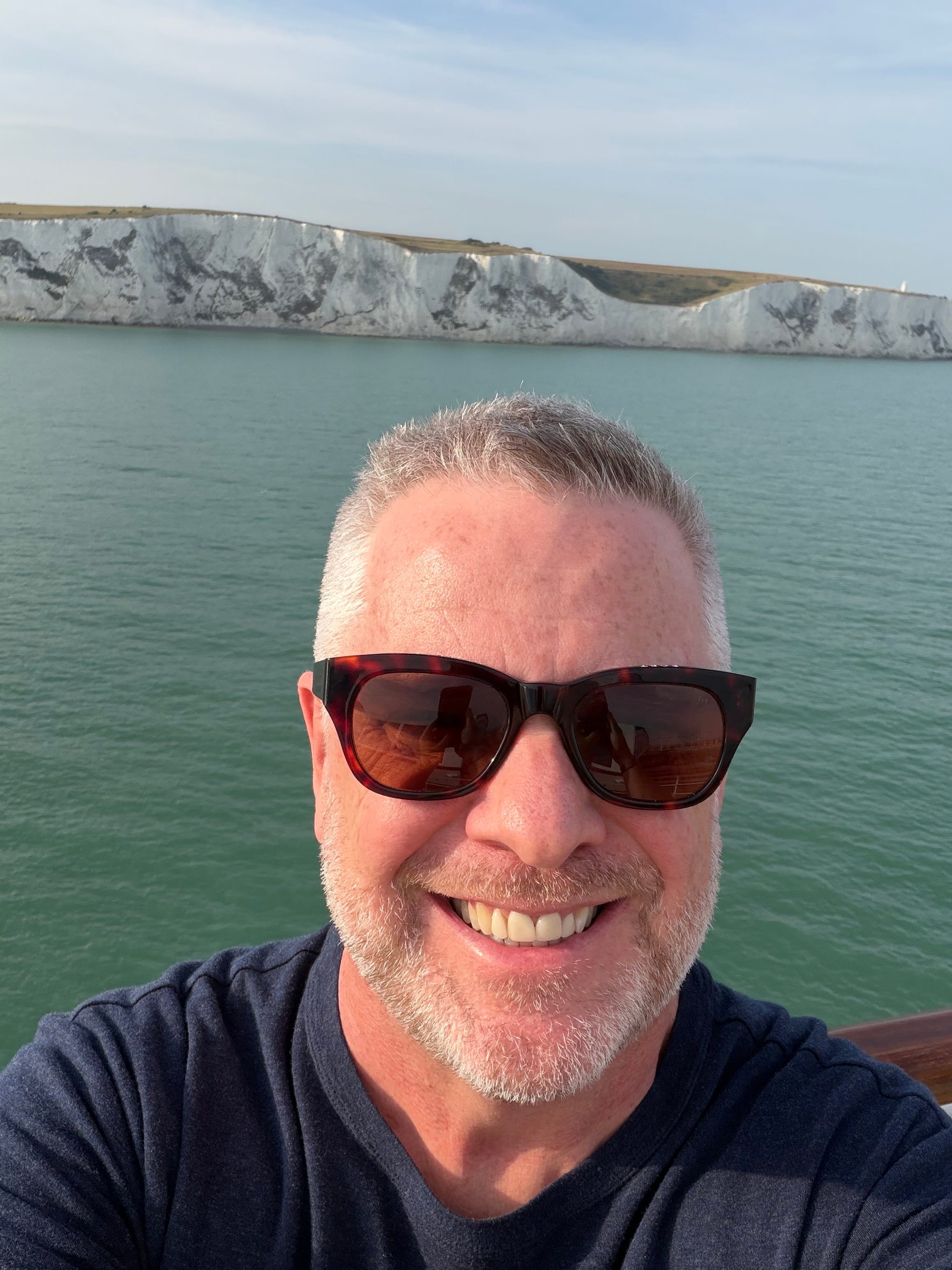
I got up at 7am specifically to beat the heat. I did not beat the heat.
From the ship, downtown Dover is a flat-ish 25-minute walk through a working port so large and so committed to being a working port that it stops being scenery almost immediately and just becomes a fact you walk through.
I stopped at Marks & Spencer for provisions, a tuna and sweetcorn sandwich — a combination that sounds wrong and is, somehow, perfect. I've developed something bordering on a dependency over the last two weeks; every UK port has one. This would be my last for a while, so I bought two. Don’t judge me.
The path up to the cliffs starts less scenic than advertised — a stretch of graffiti, a bridge underpass, some bushes I couldn't quite shake the feeling were watching me back.
Eventually it turns into what I'd call an actual path, except it isn't flat there either, and you have to watch your footing the whole way up.
The more carefully I watched my footing, the more rattled I got by how close the edge actually was — which seems backwards, I know, but there it is.
Maybe that's what happens when you take yourself off autopilot. You start noticing the drop.
Nobody puts up a fence. No waiver, no rope, no sign that isn't really just a suggestion. You're right there at the edge if you want to be, because apparently somewhere in the world still operates on the principle of you do you, we're not your mother.
Back home there'd be a barrier, a sign, and a form to sign in triplicate. Here it was just me, several hundred feet of open air, and whatever judgment I'd shown up with that morning.
The sun, meanwhile, had fully committed to the bit. No clouds, no shade, no wind off the Channel to save me from myself.
Just white chalk, a straight drop, and a lighthouse up ahead that I'd built into a whole small ceremony in my head — the last stop of a two-week crossing, my Cliffs of Dover moment.
I had a bar set for what that moment could be, and it was set at Callanish. Same cruise, a week earlier. I'd taken a cab out at 9pm — still full daylight this far north — on a whim, and got mist and fog rolling low over five-thousand-year-old standing stones, the temperature actually cool for once, and the entire site to myself for the better part of an hour.
It was the kind of thing that takes your breath before your brain has caught up to why. Easily the high bar of the whole odyssey. I was hoping Dover might be a close second.
I got about halfway. Thirty minutes out from the lighthouse, walking a stretch with a genuinely no-nonsense drop to my right, I looked at the little blue line on my phone still snaking ahead of me and thought of a philosopher named G.E.M. Anscombe, who spent a career arguing that what makes an action actually yours — intentional, not just something your body happened to do — comes down to one test.
Can you answer the question "why are you doing that?" Not the answer you'd give a stranger to end the conversation. The real one.
I asked myself. I didn't have one that held up. I wanted the lighthouse the way I'd wanted Callanish — some quiet, earned, sunset-mist kind of moment — and that was never going to happen in this heat, with a straight drop on one side and no idea if there'd even be a shuttle back. Some part of me already knew that.
Which meant I wasn't doing this on purpose anymore. I was just moving, the same way I'd started walking from the port that morning without ever actually deciding to.
So I turned around.
This shouldn't have been a big deal. It was, a little. Some version of me — the one that's been running the show for thirty years — does not turn around thirty minutes from the thing he came for.
That version finishes the hike, gets the photo, earns the ending. It took actual heat and an actual drop to get that guy to stand down long enough for someone else to make the call.
I've technically walked the Cliffs of Dover. Nobody's going to argue the point. I'm fine with that.
And I'm not sure it would've been Callanish even if I'd pushed through. The cliffs are beautiful — genuinely, structurally beautiful, chalk-white and enormous — but the view from up there is mostly the working port of Dover, cranes and container ships, not mist and quiet and five thousand years of silence.
I can't blame the cliffs for the heat. But the heat had already taken the joy and the hydration out of me, and there wasn't a lot of mystical left to salvage even if I'd made it to the lighthouse.
I got back to the ship, lay flat on the cabin floor for the better part of an hour, showered, and went up to the Crow's Nest because I needed a cappuccino and about a liter of water.
And there they were. The cliffs, the whole sweep of them, white against the water. The lighthouse. The path I'd been on, traced clean along the top from this height. I could even pick out the spot where I'd stopped and turned around.
I didn't feel regret. I felt something more like irony, standing there with a very good cappuccino, looking at the better view of the thing I'd nearly cooked myself trying to reach on foot.
The walk wasn't wasted — my legs would disagree with anyone who said otherwise, and there's something to be said for having actually stood on the chalk instead of only photographing it from a boat.
But I keep turning over the same unglamorous question, and I don't have a tidy answer for it yet: at this age, do I really need to make things this hard on myself to feel like I've earned them?
I'll be back in Dover in October. Maybe that's a better time to try the lighthouse properly. Or maybe I'll get a cappuccino instead and call it even.
Sean, from Slow Crossings: written somewhere off the coast of Dover, half a hike short of a lighthouse.
Sean owns Slow Crossings, where he designs trips for travelers who want it done right and offers coaching for life's bigger transitions — if either's ever useful, reply or check the About page.