

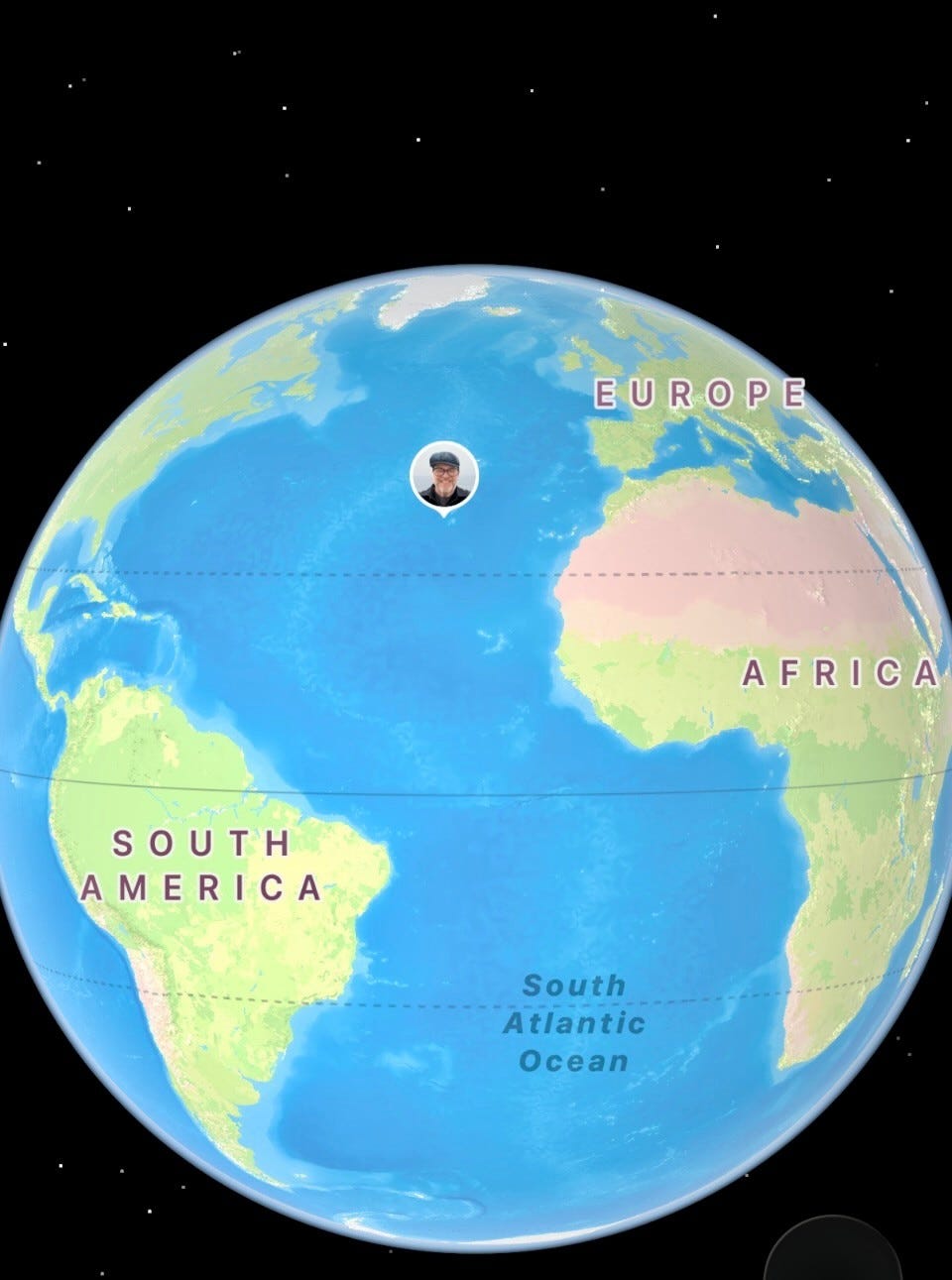
I turned fifty-nine in the middle of the Atlantic, on a Holland America ship bound for Rotterdam, with nothing out the window in any direction but water. Nine days at sea. No coastline, no city, no real way to mark a birthday except the kind of thing you do when you’ve lost track of where you are — I opened the map on my phone and looked for myself on it.
There I was. A small blue dot, alone in an enormous field of blue, a very long way from anything. And I sat there longer than the moment really called for, because the map had quietly done something I wasn’t expecting. It made me think about my whole life, and how oddly difficult it is, most of the time, to tell how far I’ve actually come.
Here’s what I noticed, sitting there. The same crossing looks like two completely different things depending on how far you zoom out.
Pull all the way back to the globe and the whole Atlantic crossing is a thin thread of dots you'd miss if you weren't looking for it — the ocean enormous, the ship not even a speck on it. Zoom all the way in, mid-crossing, and you might expect a harbor, streets, a named place — but there's nothing down there to find. Just a bigger patch of the same blue, my marker alone in the middle of it, and the label on the water changing from "North Atlantic Ocean" to, if I'm honest, more North Atlantic Ocean. Same ship. Same Nine days. Pulled out, the trip is a speck on a planet. Zoomed in, it's still a speck — only now you can see how much water is holding it up. Nothing changed but the distance I looked from.
That got me thinking about the two different ways the crossing was telling me I was moving — and how they don’t agree with each other.
A ship gives you something almost nothing else in life does: you can feel that you’re moving. The engine is under your feet all day. There’s a wake. The deck has a long, slow lean to it that you stop noticing by day three and then notice all over again the first night it’s gone. My body knew the ship was going somewhere. But — and this is the strange part — that feeling told me almost nothing about distance. Day six and day nine were identical. Take away the day I boarded and the day I’d get off, and I genuinely couldn’t have told you whether I’d crossed an ocean or gone in a very large circle. The body knows you’re moving. The body has no idea how far.
The map is the exact opposite. It can’t feel a thing — no engine, no wake, no lean. But it knows precisely how far. Where I started, where I was, how much water still sat between me and where I was going. And when you’re disoriented in the middle of an ocean — and you do get disoriented, the blue goes on in every direction until it stops meaning anything — there is a real and specific comfort in a small dot that says you are here. Even when “here” is a thousand miles from the nearest anything. The map couldn’t tell me what the days had felt like. But it could tell me they’d added up to something.
And here’s the part I keep turning over, the part that kept me sitting there on my birthday.
Both of those were true at the same time. The feeling and the map were both running the whole crossing. I just couldn’t hold both at once, so I kept reaching for one. And then I thought about life off the ship — most of it, really — and realized that out here, most of the time, you only get one of them. Or neither. There’s no engine under your feet at the kitchen table. No blue dot on the calendar telling you you’ve come four hundred miles since spring. You’re a year or two into something — a change you chose, or a change that chose you — and there’s no instrument on the dashboard at all. Just the days.
Most of us hit a stretch like that and read the flatness as failure. I can’t feel myself getting anywhere, so I must not be. But the ship taught me those are two different facts. You can be moving and not feel it. The wake is real whether or not you’re looking at it.
So there are two moves, it turns out. Some days you trust the engine — you can’t feel that you’ve gotten anywhere, but you go ahead and trust the wake is real. And some days you take the map out on purpose, and stop, and actually look at where you started and how far that already is.
I took the Apple map out. And here’s where it had me: closer to Rotterdam than to Fort Lauderdale. Past the midpoint. More water behind me than ahead. At fifty-nine, I know exactly what shape that is, and I’m not going to pretend the map was only ever about the ship.
But that’s only half of what the map showed me, in the same glance. My back already knows I’m past the middle, frankly, and so does the bald spot I only ever see by accident. The new information wasn’t that. It was the water still out there. I can’t always see it, but I know it’s there — the way you know the ship is moving even on the days the ocean looks exactly the same. Not infinite. But not nothing.
And I find I want to spend it the way I wish I’d spent more of the years before now: awake to it, grateful for it, and in no particular hurry to be anywhere but here.
—Sean