
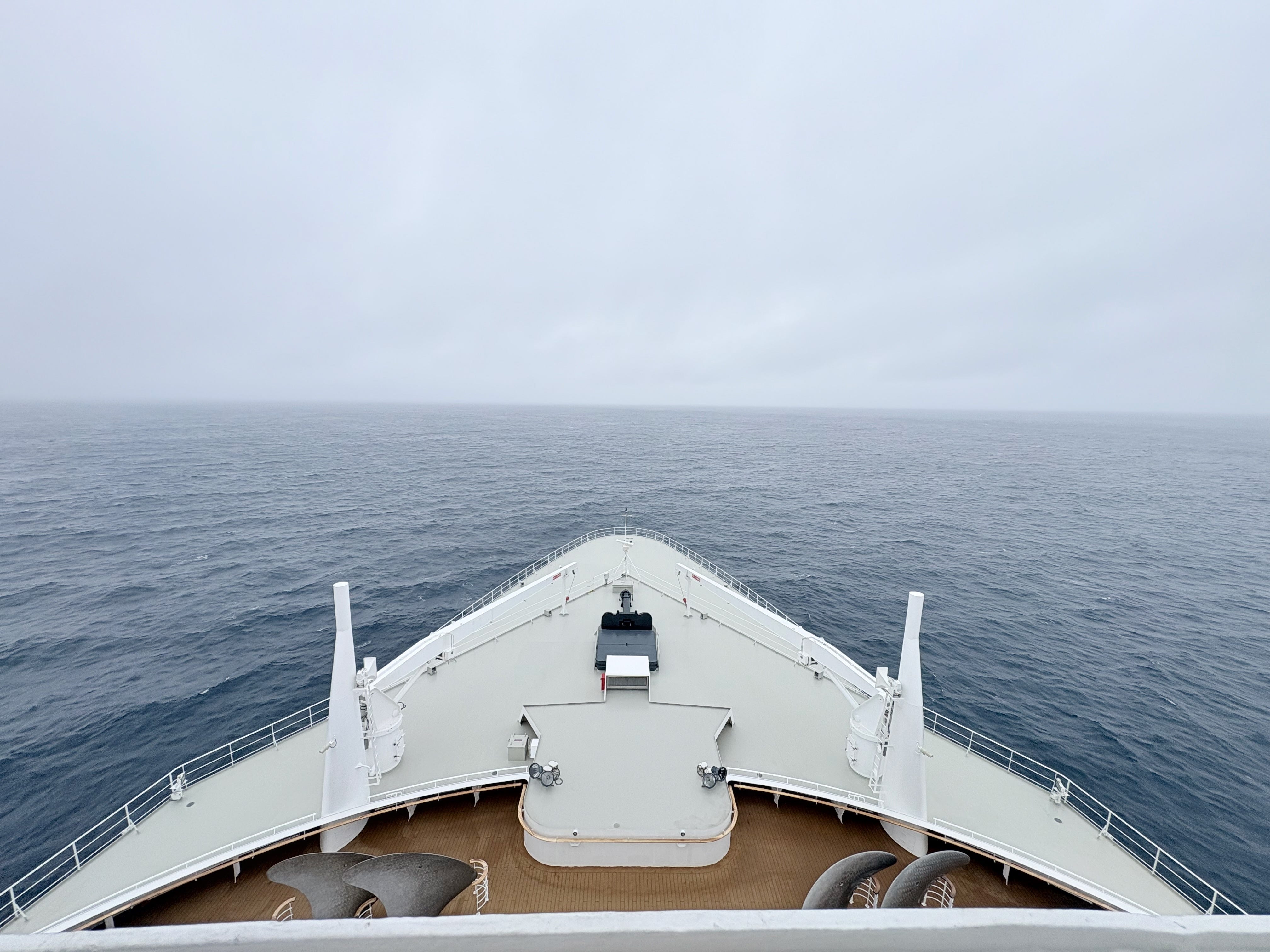
I just got home from fourteen days on a transatlantic crossing. Alone.
Not alone in the sense of nobody else on the ship. Alone in the sense that this was mine — not a trip I took with someone, not a vacation, not a shared experience to talk about afterward at parties. Fourteen days of open ocean, at a pace that only made sense to me, doing interior work I couldn’t have done in the company of someone else I loved.
I want to write about what made that possible, because I think most people get this wrong.
Solo crossings are often framed as escape — from work, from obligations, from relationships, from the noise of other people’s needs. The cultural story about the person who goes off alone is that they’re running from something. Or proving something. Or claiming something.
That’s not my experience. My experience is that a genuinely good solo crossing is made possible by a specific kind of partnership at home. Not despite it. Because of it.
I want to be careful here because I’m going to say something that’s easy to misread.
I come home to someone who actually wants me to go. Not in the way people sometimes mean that — not permission given, not tolerance, not a deal we worked out — but wanting it for me, because they understand what it does.
I know that’s rare. I know how rare it is because of the voice that runs in my own head — a voice that expects to be in trouble when I get home. That expects to pay for the going in some subtle way. That expects support to come with a receipt.
That voice is mine, not theirs. I want to be specific about that. It isn’t evidence that I’m poorly supported. It’s evidence of what I grew up believing, what I’ve learned to expect, what most people with any real history carry — the idea that asking for space, for solitude, for time away, will eventually be held against you. That every freedom has a price. That the ledger gets settled sooner or later.
A lot of you carry some version of that voice too. Naming it is most of the work of not being ruled by it.
So here’s the thing I’ve come to understand about solo crossings.
The trip itself happens alone. You board the ship alone, you sit with yourself alone, you do the interior work alone. But the conditions that make the trip possible are not solo. They’re built over years, in partnership, through thousands of small moments where you either established that going was safe or you didn’t.
If the partnership is right, you can actually go. You can be present on the crossing because you’re not spending the whole trip managing anticipatory guilt about what’s happening at home. You’re not running scenarios about what you’re going to owe when you return. You’re not half-gone, because the other half of you isn’t preemptively paying for the going.
If the partnership isn’t right, you can go geographically, but you can’t actually arrive. You take the trip but the trip doesn’t take you, because half of you is back home, already paying.
I didn’t always know this distinction. I used to think solo meant solo. Just me, my stuff, the road, the ocean, the whatever. I had to learn that solo is a quality of the experience, not of the logistics. You can be technically alone and psychologically surrounded by obligation. You can also be technically alone and actually, finally, unescorted.
The second kind of alone requires a base that doesn’t punish you for needing it.
The part I most want to name, though, is what this kind of support obligates me to.
Because here is where it gets real and where I stop sounding sentimental about any of this.
If I am supported in the way I’ve been describing — freely, without a ledger, without the price tag — then I owe something. Not to the person who gave me the support. To the relationship itself. To the thing we’re both in.
What I owe is this: I have to come back. Not physically — that part is easy. I owe coming back whole. Coming back with something to give. Coming back more present, not less. Coming back better at being the person who lives here, not worse.
A solo crossing that turns you selfish is a failed solo crossing. A solo crossing that turns you more available to the people you love, more attentive, more interesting, more alive — that’s the whole point. That’s what the going is for. That’s what the support was for.
The person who supports my going isn’t doing me a favor. They’re staying in the relationship while I do something I can only do alone. The deal — if there’s a deal — is that I come back with something the relationship can use.
I have to deliver on that. Not as a duty — as the actual spirit of the thing.
There’s a version of this piece that’s about how lucky I am, and I want to say clearly that’s not what I want to write.
What I want to write is that solo is not a solo thing. That the interior work most of us are trying to do in the second half of life requires going somewhere, sometimes, where the other people we love can’t follow — and that the quality of that going depends entirely on what we’re going from.
If you’re going from a base that is quietly punishing you for needing space, the work doesn’t happen. You take the trip, you don’t do the crossing.
If you’re going from a base that wants you to do the work because they want you whole, you can actually go. And if you go, you have to come back with something. That’s the exchange.
I have learned more about this in the last year than in the previous twenty. Partly because I’ve started to notice the voice in my head that still expects punishment, and started refusing to listen to it. Partly because I’ve started paying attention to what I’m actually bringing home from these crossings — is this making me a better person to be in a relationship with, or a worse one?
If the answer is “worse,” I need to stop taking the trip, or I need to change how I’m doing the trip. The going is not the achievement. The returning is.
The support at home is not free. Not because it comes with a receipt. Because it comes with a responsibility.
The responsibility is to bring back what I left to find.
That’s what I’m still learning how to do.
Sean