
I boarded with a plan.
Two books I’d been meaning to read for months. A journal I’d bought specifically for the trip. A vague intention to write something — maybe the start of something longer, maybe just notes, maybe the kind of thinking I never had time for at home.
Seven days on the Atlantic. No flights to catch, no meetings to prepare for, no one who needed me to be any particular version of myself. I’d finally have time to think.
That was the plan.
The first two days, my body didn’t know what to do with itself.
I kept checking my phone, even though it had no signal. I’d pull it out, stare at it, realize there was nothing to check, put it back. Ten minutes later, I’d do it again. The motion was so automatic I couldn’t stop it. My hand kept reaching for a weight in my pocket that no longer meant anything.
I checked the time constantly. Not because I had anywhere to be — I didn’t — but because I’d spent thirty years organizing my life in increments. Time was how I knew what to do next. Without a schedule, I felt untethered in a way that wasn’t peaceful. It was disorienting. Slightly nauseating, like a different kind of seasickness.
I walked the deck. I ate meals. I sat in the library with one of those books I’d brought and read the same paragraph three times without absorbing it. My nervous system was tuned to a frequency that no longer existed, and it kept scanning for a signal that wasn’t there.
I’d thought the crossing would feel like freedom. It felt like withdrawal.
Somewhere around day three — I couldn’t tell you the exact moment — something shifted.
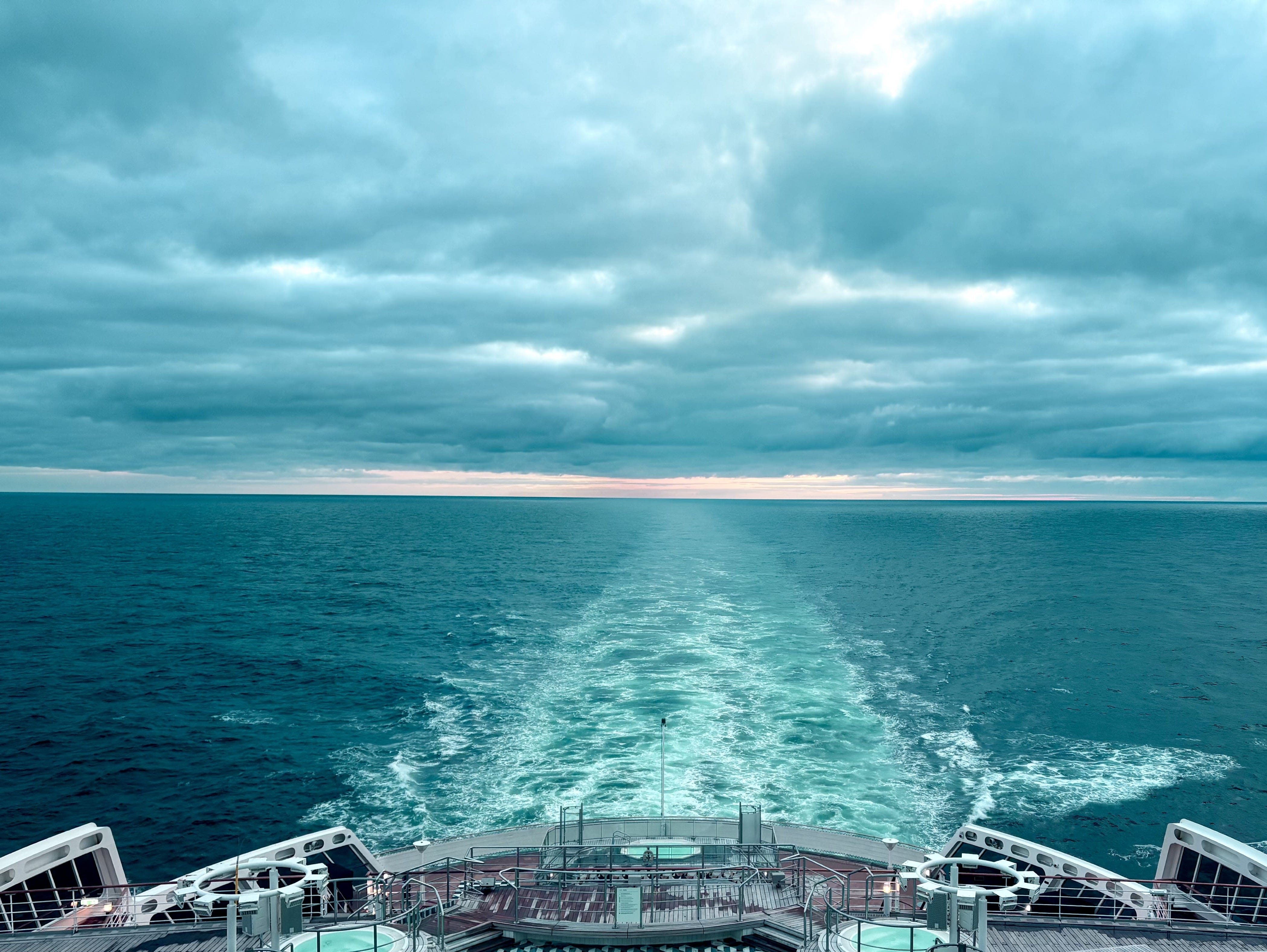
I was sitting on the Promenade Deck, early morning, before anyone else was awake. The ship was quiet. The water was gray, not blue, and the sky was the same gray, and the horizon was just a seam where two kinds of gray met. There was nothing to look at. Nothing was happening.
And I realized I wasn’t waiting for anything.
Not for the phone to buzz. Not for the next meal, the next port, the next thing. I was just sitting there, watching water move, and that was enough. My chest felt different — looser, like I’d been holding my breath for months and had finally let it out.
I don’t know how long I sat there. Time had stopped mattering in a way I hadn’t experienced since childhood. Not because I was distracted or entertained, but because there was nothing time needed to do. It could just pass.
After that, the days opened up.
I started noticing things I hadn’t noticed before. The way the light changed on the water through the afternoon — imperceptibly at first, then suddenly golden, then gone. The particular silence of a ship at night, which isn’t silence at all but a kind of hum, mechanical and alive. The strange intimacy of eating alone at a table for one, not apologizing for it, not performing anything, just being a person having dinner.
I stopped reading. The books stayed in my cabin. I didn’t write anything either — not a single note in that journal I’d bought. What I did instead was think. Or not even think, exactly. More like... let things surface.
Things I hadn’t had time to feel in years came up and asked to be felt.
Grief I’d deferred. A friendship I’d let go of without acknowledging it. The slow recognition that I’d been performing a version of myself for so long I’d forgotten what the original felt like. The fear — not anxiety, but something older and quieter — that I might have already made the choices that would define the rest of my life, and I wasn’t sure they were the right ones.
None of this was comfortable. Some of it was the kind of thing you spend years avoiding precisely because you don’t want to feel it. But out there, with nothing to distract me, nowhere to be, no one to perform for, it came up anyway. The ocean doesn’t care what you’re ready for.
I let it come. I didn’t try to solve it or organize it or turn it into a plan. I just sat with it, day after day, watching the horizon, letting the thoughts move through me like weather.
By day six, I felt different. Not fixed. Not resolved. Just quieter inside.
I’d arrived on the ship certain about a lot of things. What I wanted. What came next. Who I was. A week later, I was less certain about all of it — and strangely, that felt like progress. The certainty had been a kind of noise, drowning out something softer underneath. I didn’t know what that softer thing was yet. But I could hear it now. I could feel it waiting.
I packed my bag on the last morning. The books I hadn’t read. The journal I hadn’t written in. I didn’t feel like I’d failed at the trip I’d planned. I felt like the trip I’d planned wasn’t the trip I needed.
What I brought back wasn’t words or insights or a list of things I’d figured out. It was more like a recalibration. A different relationship with silence. A willingness to not know that I hadn’t had when I boarded.
A flight gets you somewhere faster. A crossing gets you somewhere else entirely.
Not a destination — that’s the same either way, a city with a name and a customs line and a taxi queue. I mean somewhere internal. A place you can’t reach when you’re moving at the speed of modern life, because that speed is specifically designed to keep you from arriving there.
The ocean doesn’t care about your plans. It doesn’t care about your productivity or your optimization or your carefully constructed identity. It just moves, endlessly, the same way it moved before you were born and will move after you’re gone. And if you stay out there long enough, something in you starts to sync with that rhythm. Slower. Wider. Less convinced that any of your urgencies are actually urgent.
I don’t know if everyone needs a crossing. But I know that I did. I know that something in me was waiting for exactly that much silence, exactly that much emptiness, exactly that many days of nothing but water and sky.
And I know I’ll go back. Not because I have more books to read or more thinking to do. But because some things only surface when you finally stop moving fast enough to hear yourself think.