
It’s not about pace. It’s about presence.
Let me tell you what slow travel isn’t.
It’s not budget backpacking through hostels with a dog-eared guidebook. It’s not the retiree bus tour hitting fourteen cities in twelve days. It’s not “see all of Europe in two weeks” or the cruise that docks somewhere new every morning before you’ve finished your coffee.
It’s not an itinerary optimization problem. It’s not about seeing more, or seeing it cheaper, or seeing it faster. It’s not about the list — the monuments checked off, the photos proving you were there, the countries counted like a score.
Slow travel isn’t about pace at all, really. You can move quickly and travel slowly. You can move slowly and never travel at all.
It’s about something else entirely.
Slow travel is staying somewhere long enough for the unfamiliar to become familiar.
It’s the moment — usually around day four or five — when you stop consulting the map. When you recognize the person behind the counter at the café. When you have a route you walk without thinking, a bench where you sit in the afternoon, a view you’ve seen enough times that it starts to feel like yours.
You’re not a tourist anymore. You’re a temporary resident. And that’s when a place starts to teach you something it couldn’t teach you in a weekend.
Slow travel is traveling to encounter yourself, not escape yourself.
Most trips are about getting away. The vacation as pressure valve. You need a break from your life, so you go somewhere your life isn’t, and you return just restored enough to keep going. There’s nothing wrong with that. I did it for years.
But there’s another kind of travel that shows up later. You’re not running from anything. You’re trying to hear something — the things you couldn’t hear when you were too busy, too scheduled, too surrounded by the familiar cues that tell you who you’re supposed to be.
Slow travel is using displacement as a tool.
When you’re home, everything around you reinforces your identity. Your routines. Your role. The way people greet you, expect things from you, see you. You know who you are because everything confirms it.
Take that away — put yourself somewhere nobody knows your name or your title or your history — and a strange thing happens. The scaffolding falls away. And you’re left with the question: who am I when none of my usual context applies?
That question can be uncomfortable. It can also be the most honest question you ask yourself in years.
Slow travel is the journey as teacher, not just transportation.
Not the destination. Not even the experience. The movement itself — the being-between, the in-transit, the neither-here-nor-there — has something to offer if you let it. The train that takes all day. The ship that takes a week. The slow accumulation of distance that gives your mind time to wander and your thoughts time to settle.
This matters differently after fifty.
You’re not young and untethered, running on caffeine and freedom, collecting experiences like stamps. You’re not filling time or checking boxes. You’re not trying to prove anything to anyone, least of all yourself.
You’re in a season where identity is already shifting. Career ending or winding down. Roles changing — the kids grown, the parents aging, the familiar definitions no longer fitting the way they used to. You’ve spent decades becoming someone, and now that someone is loosening at the edges.
Travel in this season isn’t vacation. It’s reconnaissance.
You’re scouting the territory of who you might become. Trying on different rhythms. Noticing what you’re drawn to when nobody’s watching. Seeing what surfaces when the usual distractions fall away.
This isn’t self-indulgence. It’s necessary work — the kind that’s hard to do at home, where everything conspires to keep you who you’ve always been.
And then there are ocean crossings.
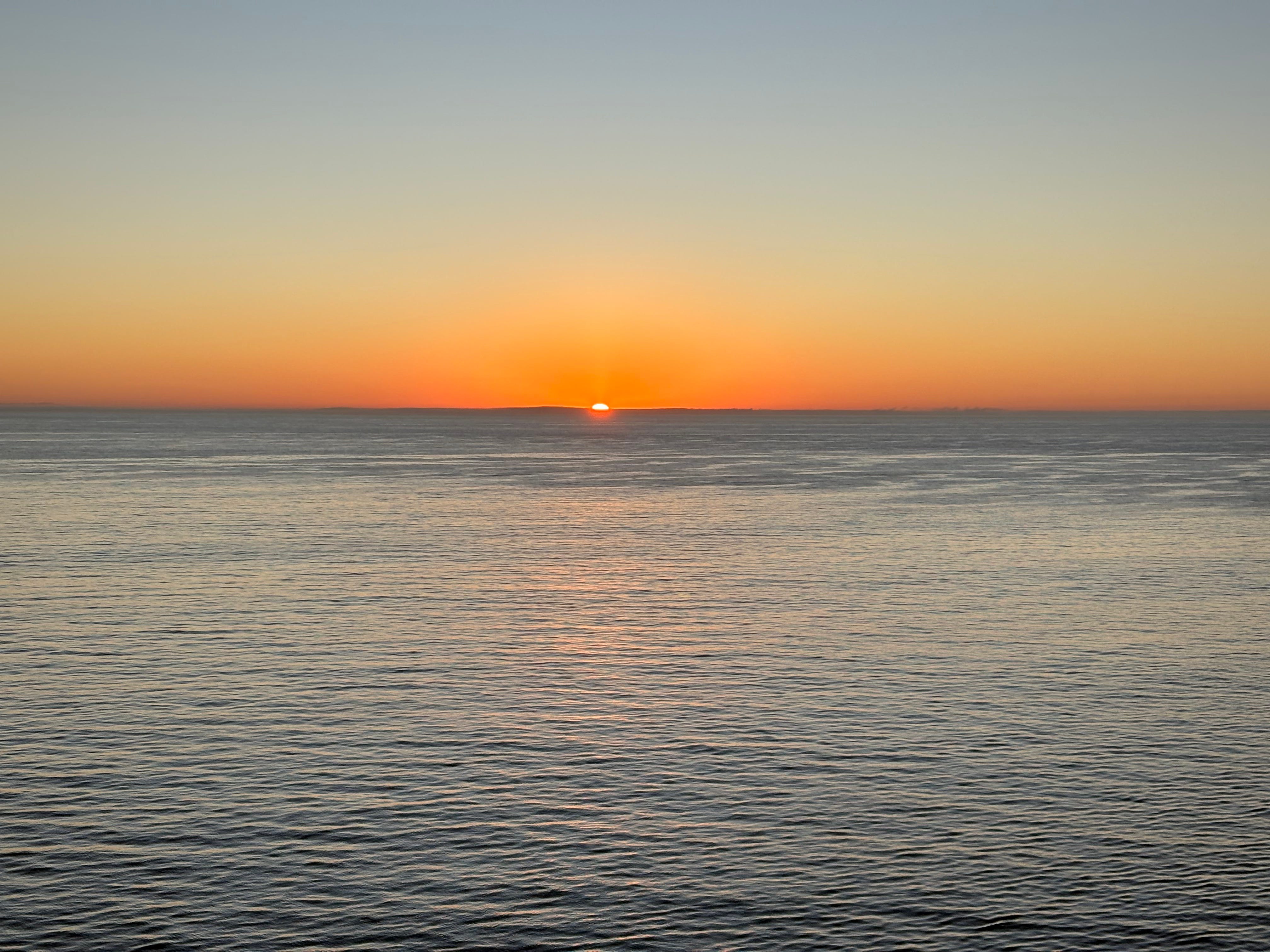
I’ve done enough of them now to know they’re their own category. Not because the ship is fancy or the food is good — though sometimes both are true — but because of what happens when you spend days surrounded by nothing but water and horizon.
No ports to distract you. No excursions to fill the time. No decisions to make except when to eat and whether to sit on the port side or the starboard side and what to read in the afternoon.
You are, for a few days, genuinely unreachable. Genuinely unhurried. Genuinely unscheduled.
The first day or two, your body doesn’t know what to do. You keep checking your phone. You feel restless, purposeless, slightly wrong. You’re so accustomed to being needed, being busy, being useful, that the absence of all three feels like vertigo.
And then something shifts.
You stop reaching. You start noticing. The light changing on the water. The rhythm of the ship. The thoughts you haven’t had time to think in years, surfacing like they’ve been waiting for exactly this much silence.
A crossing is a liminal space in the most literal sense — you’re between places, between time zones, between the life you left and the life you’re heading toward. And there’s something about being suspended over all that water, all that depth, that makes it easier to let go of what you’re carrying and harder to pretend you’re fine when you’re not.
I can’t explain it better than that. You have to feel it.
This newsletter is for people who suspect the right trip at the right time might change something.
Not every trip. Not every time. But sometimes — when you’re ready, when you’re paying attention, when you’ve given yourself enough space — travel does more than entertain you. It rearranges you. It shows you something you couldn’t see from home. It gives you back a piece of yourself you didn’t know you’d lost.
Twice a month, I write essays about travel that means something. Not itineraries. Not reviews. Not the mechanics of how to get there or where to stay. The deeper question: what happens to us when we leave the familiar behind?
If you’re in the second half of life and you’re looking for something you can’t quite name — if you’ve started to wonder whether the next trip might be different from all the ones before — you’re in the right place.
Welcome.